Master of Science in Engineering thesis, Florida Polytechnic University, Spring 2020. Research funded in part by Brad Feld of Foundry Group.
The problem
Fragile, deformable, or oddly shaped objects need grippers that touch them at many points along their outer contour and spread the force out, rather than pinching. Picture a "snowman" — two spheres joined at a narrow neck. The weak point sits at a concave cusp of the outline, so a gripper has to form concave angles along its own length to secure it. The usual answers — soft robotic actuators, hand-like grippers — are expensive to design, build, and maintain.
The idea: a lattice that folds to a shape
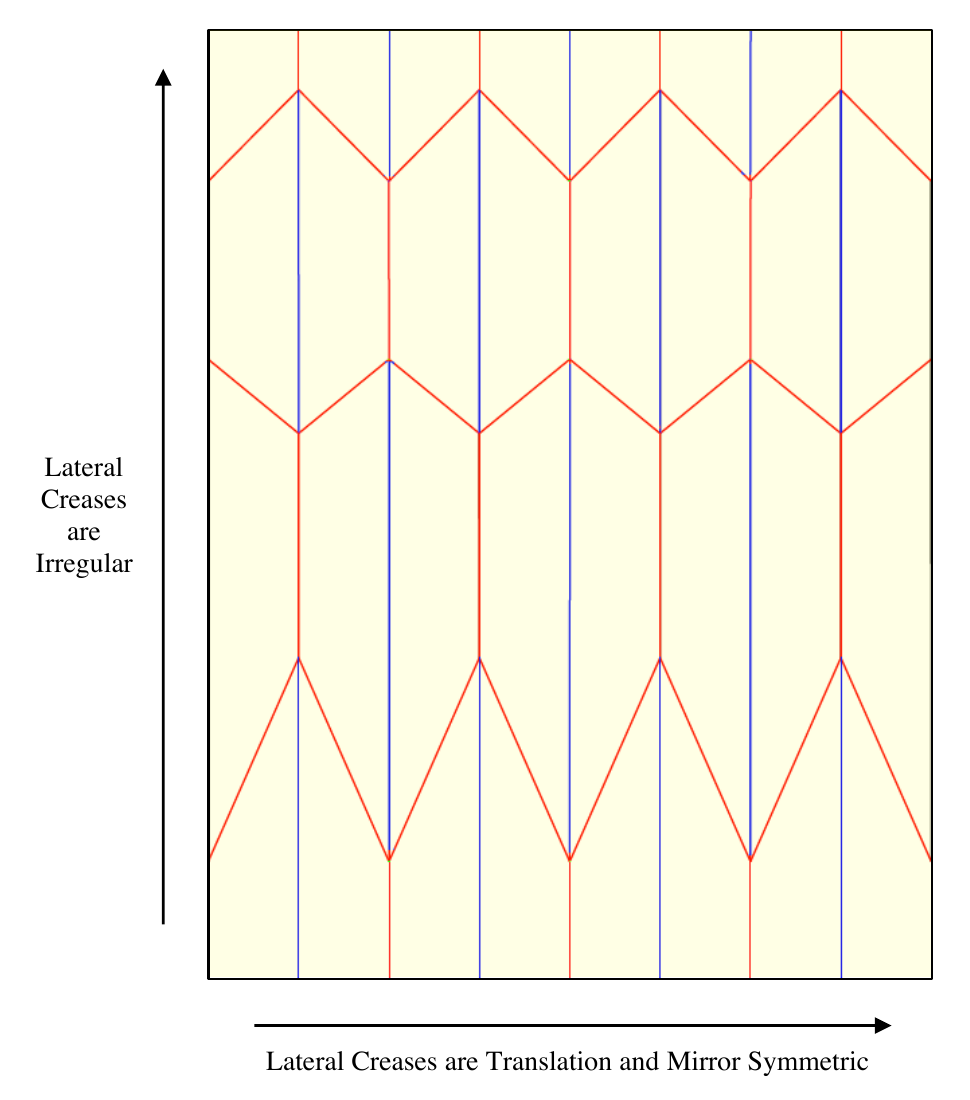
Origami tessellations are sheets folded into a periodic structure, and they come with unusual mechanical properties for free: the sheet is cheap, light, flat when stored, and a single part. The thesis uses irregular hexagonal tessellations (IHTs) — crease patterns with translational and mirror symmetry along one axis, a subset of the hybrid Yoshimura–Miura pattern — chosen because every crease in the pattern can be driven by a single parameter. Despite many moving facets, the resulting gripper is a one-part mechanism with one degree of freedom: compress its width and it closes, with an even gripping force distributed along its whole length.
The mathematics
The core contribution is a parameterization that turns "fold to this contour" into something a program can solve in closed form, with no numerical optimization. The target contour is a linear chain of segments. A case analysis of any three consecutive segments — which side the object is on, whether the two turns share a sign, and which side of the sheet the raw edge lands on — gives sixteen cases that mirror symmetry collapses to eight, each with a one-line formula for the sheet length that segment needs. Because each formula depends only on its neighboring angles, the whole crease pattern comes out in a single linear pass over the chain.
A second construction, about a single vertex, gives the fold angles as explicit functions of one folding parameter (the sheet's width compression), so the mechanism has exactly one degree of freedom. Plotting the contour angle as isolines over the design-and-folding space characterizes the whole mechanism at once, and yields a useful engineering fact: once the sheet is 80% folded, every contour angle is within 2% of its final value — so width control near the grip is forgiving — but the gripper has to open to under 30% folded to clear the object. The approach is compared against TreeMaker and Origamizer, which solve for a final folded form numerically and say nothing about how the sheet moves along the way.
Tooling and results
I built the pipeline end to end: trace the object's outline as an SVG path, generate the crease pattern as SVG, and animate the fold — each lateral crease a Rodrigues rotation composed down the sheet with homogeneous transformation matrices, with the pattern's mirror and translational symmetry meaning only one column has to be solved. Patterns were scored on a Cricut cutter and folded into three paper manipulators: the snowman cross-section, whose folded states match the simulated frames; a stone statue head with an odd, slick geometry, picked and placed by pinching the top of the manipulator; and a cluster of three beverage cans, which the folded sheet held at full weight.
The thesis stops at the geometry and the hand-actuated proof of concept: the prototypes were closed by hand or by rubber bands, the physical-versus-simulated comparison was visual rather than measured, and motorized actuation of the single degree of freedom was left as future work.
Why it stuck with me
It's the same instinct as everything else on this site, expressed in geometry: take a hard constraint problem — make a periodic 2D lattice conform to an arbitrary shape under one control input — find the parameterization that makes it tractable, and then build the generator so the solution is a tool rather than a one-off.
Committee: Dr. Balasubramaniyan Chandrasekaran (chair), Dr. Mary Vollaro (co-chair), Dr. Jared Bunn, and Dr. Onur Toker. With thanks to Dr. Tom Dvorske and Dr. Melissa Morris.